

 Free Minecraft Server


Hosting vendors and a browser networking library describe how peer to peer and dedicated servers differ in ping, cost, cheating risk and IP exposure.
Peer to Peer vs Dedicated Server: The Trade-Offs in Latency, Cost and Cheating
Hosting vendors and networking libraries describe two models for running online matches, one where a player's device acts as host and one where a separate server does, and the differences show up in ping, hosting bills and security.
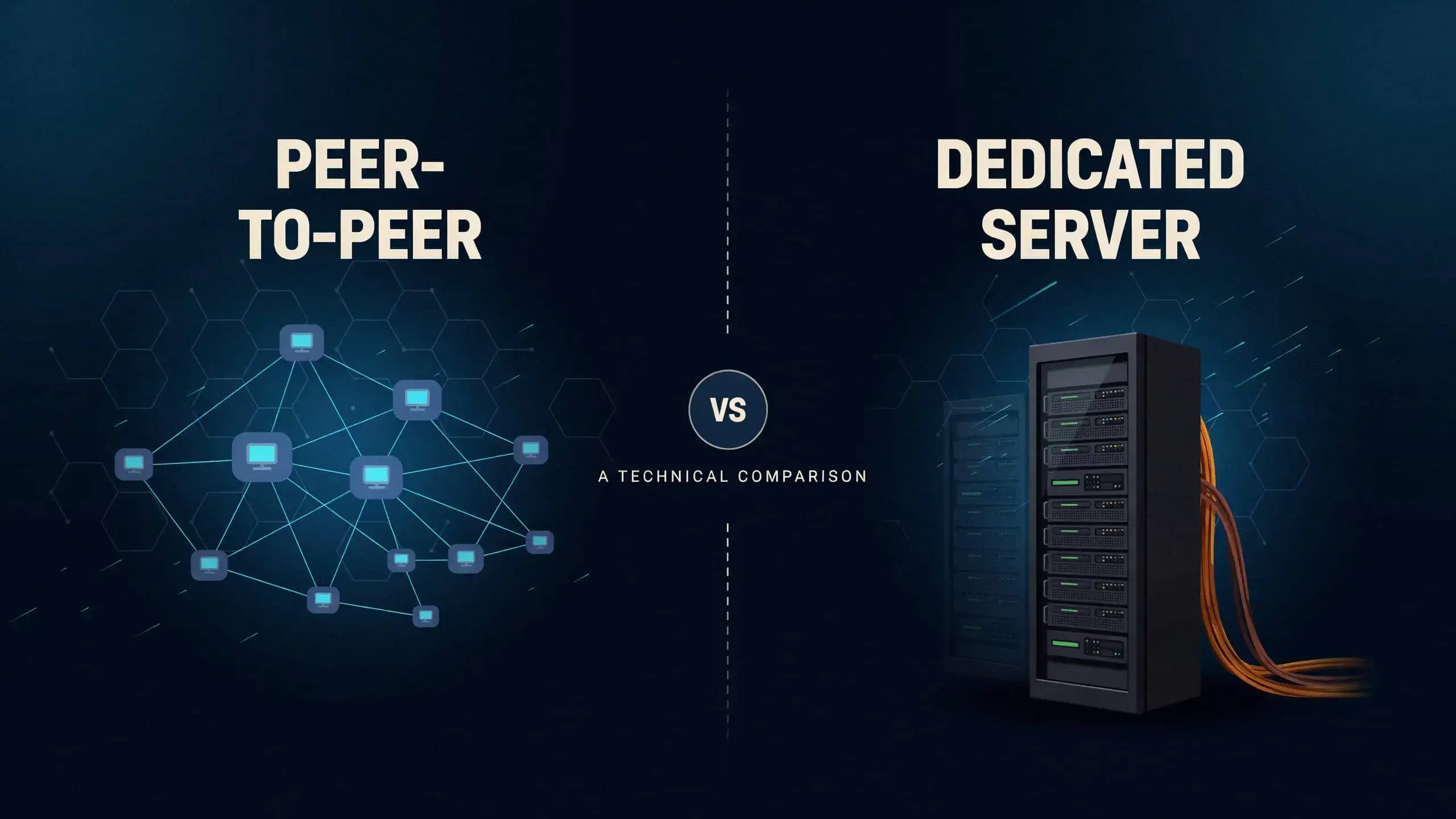
Every online match needs one machine to settle what actually happened. Whether that machine belongs to a player or sits in a data center is the core of the peer to peer vs dedicated server question, and the answer shapes ping, hosting bills and how easily a match can be cheated.
What peer to peer and dedicated servers mean
In a peer to peer setup, players connect directly to one another, and often one player's device acts as host and runs the game logic. A dedicated server is a separate machine that dictates the game state, taking in player inputs and enforcing the rules. Edgegap, a hosting vendor, treats dedicated, headless and authoritative servers as the same idea.
Peer to peer vs dedicated server on latency
In peer to peer play, performance depends on the home internet connections of the people in the match, according to servers.com by Nexcess, a provider that sells dedicated server products. If the host leaves or has a poor connection, other players can be affected and the game can end. The host also gets near-zero ping, which the company describes as an advantage in competitive play. It adds that peer to peer suits games where players are geographically close, and that global play will likely be slower.
Edgegap makes the matching point for server-based play. A geographically distributed server network gives every player a more equal ping, while a peer to peer host may hold a latency edge.
Cost and who pays for it
Money is where peer to peer wins. Edgegap ranks peer to peer as the cheapest option, with no server infrastructure to provision and no ongoing hosting bill. Dedicated servers sit at the other end. They are paid for on demand or around the clock and need an orchestration layer, a cost the company says can exceed what a small game with few concurrent players requires. Relay setups fall between the two, and the article adds that relay infrastructure in Unity, Steam or Epic Online Services may come at no extra cost for studios already in those ecosystems.
Cheating and security
Edgegap lists lag-switching, speed hacks, host manipulation and modified local game files among the exploits peer to peer games are exposed to, and says server-based setups resist them.
AccelByte frames the difference around who holds the authoritative copy of the game. With a dedicated server, players cannot directly manipulate game state, so cheating still happens but anti-cheat systems get a trustworthy reference point. In peer to peer, game logic runs on a player's machine, which makes cheating easier to implement and harder to detect.
Why connections sometimes fail
Direct connections between players have to get through home routers, and the process fails on a meaningful share of networks. Relay setups avoid the problem by sending every player to one known address and port. Edgegap's article says relays also remove the need to expose any player's IP address to others in the lobby.
Exposure also comes with servers run from home. AxentHost's article on what a home-hosted server reveals to players states that every player who joins a home game server receives its public IP address.
Peer to peer vs dedicated server in practice
Poki's networking library, Netlib, shows how one platform applies the peer to peer model to browser games. The project lets players connect directly through WebRTC data channels, with no central game server, which it presents as a way to lower latency and reduce server costs. Those are the same two trade-offs the vendors above describe.
It also carries the model's known weak points. A signaling server handles peer discovery and lobbies, STUN servers help peers find their public IP addresses, and TURN relay servers carry traffic when a direct connection fails, a relay of the kind described above. Developers can pick reliable or unreliable delivery, comparable to TCP and UDP, and the project calls itself a beta under active development.
On the player side, the page for multiplayer games on Poki advertises more than 150 free titles that run in the browser on desktop, mobile and tablet, sorted into private rooms joined by code or link, public matchmaking, turn-based online play and local play for up to four players on one keyboard. The page lists these by how players join and does not say which networking model each game uses.
Games on each side
Servers.com says peer to peer suits low-cost games or players in close proximity, and recommends dedicated servers for developers who want to avoid lag, slow loading, lost files, interrupted games and crashes. It sorts well-known games into each model as follows.
- Peer to peer: Animal Crossing: New Horizons, Super Smash Bros. Ultimate, GTA Online and Demon's Souls.
- Dedicated servers: Minecraft, 7 Days to Die, Counter-Strike: Global Offensive and Rust.
Reading about servers is fine. Running one is better.
Every guide on this blog was written against a real free AxentHost server. Claim fifteen credits and follow along on your own.